Printable
Slow cooker conversion chart
Five tables on one printable sheet: oven to crockpot, crockpot to oven, High to Low, slow cooker to Instant Pot, and the temperatures to pull each food at. Print with your browser's print command; headers and ads are hidden automatically.
Tables checked September 14, 2026
Oven → slow cooker
Beef, pork, lamb braises. Chicken and casseroles: use about 80%. Desserts: about 65%.
| Oven | High | Low |
|---|---|---|
| 15 min | 1 h 30 min | 3 h |
| 20 min | 1 h 30 min | 3 h |
| 25 min | 1 h 30 min | 3 h |
| 30 min | 1 h 30 min | 3 h |
| 40 min | 1 h 30 min | 3 h |
| 45 min | 1 h 30 min | 3 h |
| 1 h | 2 h | 4 h |
| 1 h 30 min | 3 h | 6 h |
| 2 h | 4 h | 8 h |
| 3 h | 6 h | 12 h |
Cut liquid by a third (not soups). Sear first. Add pasta, rice and dairy in the last 30 minutes.
Slow cooker → oven at 325°F
Covered. 1 h Low = 15 min, 1 h High = 30 min, minimum 30 min. At 350°F take 15% off.
| Hours | On Low | On High |
|---|---|---|
| 1 h | 30 min | 30 min |
| 2 h | 30 min | 1 h |
| 3 h | 45 min | 1 h 30 min |
| 4 h | 1 h | 2 h |
| 5 h | 1 h 15 min | 2 h 30 min |
| 6 h | 1 h 30 min | 3 h |
| 7 h | 1 h 45 min | 3 h 30 min |
| 8 h | 2 h | 4 h |
| 9 h | 2 h 15 min | 4 h 30 min |
| 10 h | 2 h 30 min | 5 h |
| 11 h | 2 h 45 min | 5 h 30 min |
| 12 h | 3 h | 6 h |
Add a third more liquid. Check from 15% under the listed time.
Slow cooker High ↔ Low
1 h on High = about 2 h on Low. Read across in either direction.
| On High | On Low |
|---|---|
| 1 h | 2 h |
| 1 h 30 min | 3 h |
| 2 h | 4 h |
| 2 h 30 min | 5 h |
| 3 h | 6 h |
| 4 h | 8 h |
| 5 h | 10 h |
| 6 h | 12 h |
Both settings end at the same simmer; High just gets there faster. Poultry: first hour on High, then Low (USDA).
Slow cooker → Instant Pot (minutes at High pressure)
Hours on Low. For High, read the row for double the hours. Add 10–15 min to come to pressure, plus the release.
| On Low | Beef or pork in chunks | Whole roast, brisket or pork shoulder | Chicken thighs, breasts or a whole bird | Dried beans or lentils | Soup, vegetables or grains |
|---|---|---|---|---|---|
| 2 h | 20 min | 45 min | 10 min | 15 min | 5 min |
| 4 h | 20 min | 45 min | 10 min | 20 min | 10 min |
| 6 h | 30 min | 45 min | 15 min | 25 min | 15 min |
| 8 h | 40 min | 55 min | 20 min | 35 min | 20 min |
| 10 h | 50 min | 1 h 10 min | 30 min | 45 min | 25 min |
| Release | Natural release 10–15 minutes | Full natural release | Natural release 5–10 minutes | Full natural release | Quick release |
Pull it at
| Chicken and turkey | 165°F / 74°C | Thighs are better at 175°F+ |
| Pork chops, loin | 145°F / 63°C | Rest 3 minutes |
| Pulled pork, pork shoulder | 200–205°F / 93–96°C | Collagen has broken down |
| Beef stew, pot roast, brisket | 195–205°F / 90–96°C | Fork-tender, not just 'safe' |
| Ground meat (chili, meatballs) | 160°F / 71°C | |
| Casseroles with egg or dairy | 160°F / 71°C | Center should be set |
slowcookerconverter.com · rules of thumb from published Crock-Pot and Pillsbury tables, USDA temperatures. Always verify with a thermometer.
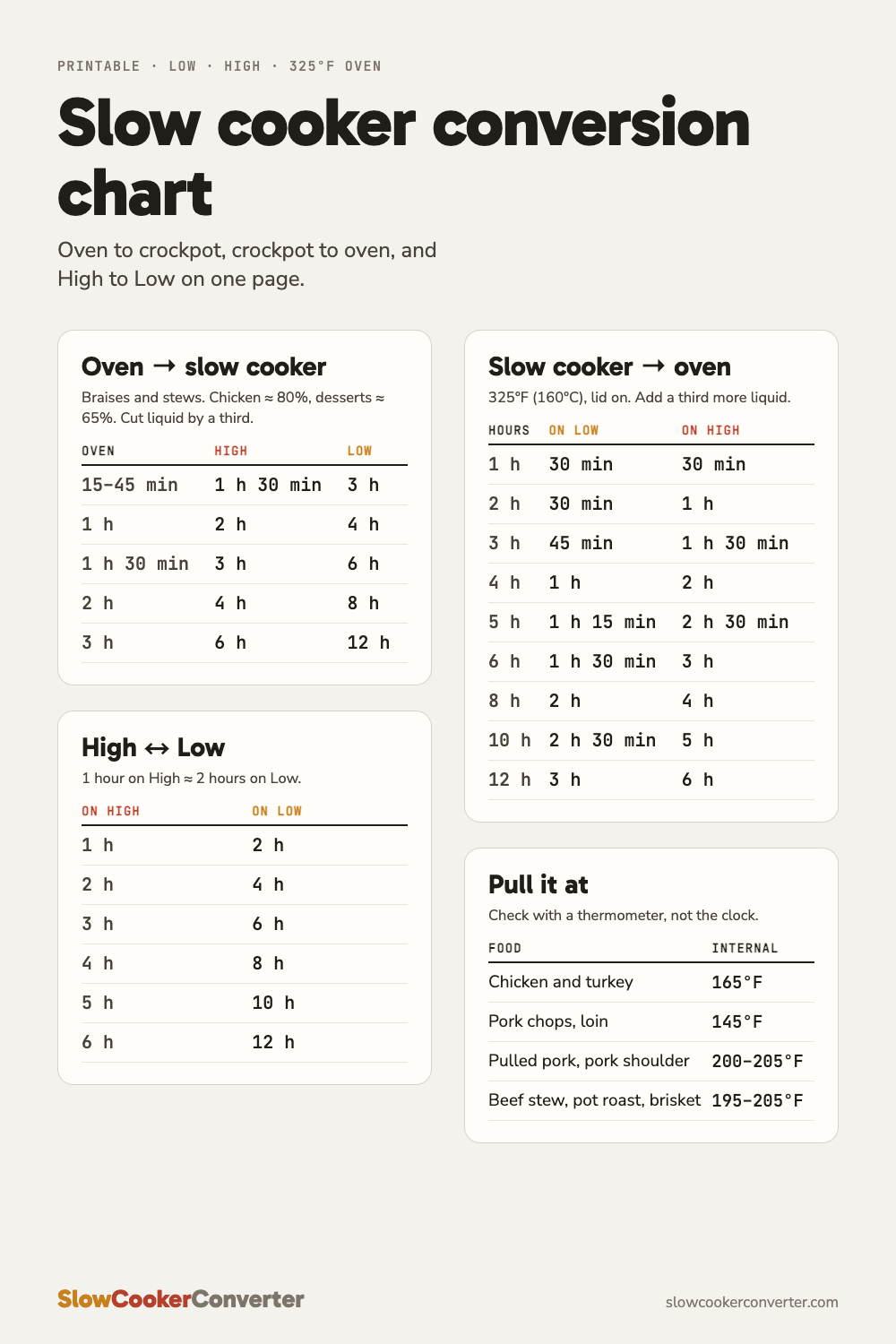
Save the chart as an image
The tables above print on one sheet. If you would rather keep the chart on your phone, pin it, or tape it inside a cupboard door, here it is as a single picture with the oven, crockpot and High to Low conversions and the temperatures to pull each food at.
How to read the chart
The two tables at the top are the same conversion run in opposite directions, and between them they answer almost every question people bring to a crockpot. Start from whichever time your recipe gives you. If the recipe is written for an oven and you want to use the slow cooker, read down the left column of the first table and across to High or Low. If the recipe is written for a crockpot and you need the oven instead, use the second table: every hour on Low is worth about 15 minutes at 325°F, and every hour on High about 30 minutes. If the recipe says High and you want to leave it on Low while you are out, the third table does that swap: double the hours going to Low, halve them going to High.
Both directions carry the same two adjustments, and skipping them is the usual reason a converted recipe disappoints. Going into the slow cooker, cut the liquid by about a third, because almost nothing evaporates under a sealed lid; soups are the exception, where you keep the full amount. Coming out of the slow cooker into the oven, add roughly a third more liquid, because even a covered Dutch oven loses moisture over two hours (the Dutch oven converter works out the cups for you). Sear meat in a pan first in either direction if the original recipe relied on browning, since no crockpot gets hot enough to do it.
The first table is calculated for beef, pork and lamb braises, the cuts that take conversion best. For chicken and casseroles use about 80% of the listed slow cooker time, and for desserts about 65%; both overcook long before a chuck roast does. The Instant Pot table is listed in hours on Low, so for a recipe written on High, read the row for double the hours. The minutes shown are time at pressure only, and you should add 10 to 15 minutes for the pot to come up to pressure plus the release time on the bottom row.
Times are a plan; the last table is the answer. Every number above is a rule of thumb drawn from published Crock-Pot and Pillsbury conversion tables, and the variation between one pot and the next is wide enough that an instant-read thermometer beats any chart, including this one. Convert with the tables, then cook to temperature. If you would rather enter your own numbers than read across a row, the slow cooker to oven calculator, the oven to slow cooker calculator and the Instant Pot converter run the same maths with the food-type adjustments already applied.
Slow cooker conversion chart: common questions
▸Is a crockpot the same as a slow cooker?
Yes, for every purpose on this chart. Crock-Pot is a brand name (Sunbeam Products) that became the generic word for the appliance in American kitchens, the way Kleenex did for tissues. Every time and temperature here applies whether your pot says Crock-Pot, Hamilton Beach, Ninja or nothing at all. The only real differences between brands are how hot High runs and how quickly the pot gets there, which is why you check doneness with a thermometer rather than trusting the clock.
▸What is the oven to crockpot conversion?
Multiply the oven time by 2 for High and by 4 for Low. A 45-minute oven recipe is about 1 hour 30 minutes on High or 3 hours on Low. Nothing converts to less than about 1.5 hours on High, because the pot needs an hour just to come up to temperature. Cut the liquid by about a third, since almost nothing evaporates under the lid.
▸What is the crockpot to oven conversion?
Each hour on Low is worth about 15 minutes in a covered 325°F oven; each hour on High is worth about 30 minutes. So 8 hours on Low and 4 hours on High both land at roughly 2 hours at 325°F. Add about a third more liquid, because a Dutch oven loses moisture that a crockpot does not.
▸What is the slow cooker High to Low conversion?
One hour on High equals about two hours on Low. To go from High to Low, double the time; to go from Low to High, halve it. So 4 hours on High is about 8 hours on Low, and 6 hours on Low is about 3 hours on High. For poultry and anything that starts cold, the USDA suggests running the first hour on High and then switching to Low, which gets the food out of the danger zone faster without changing the total much.
▸What temperature is a slow cooker on Low and High?
Low holds food at roughly 200°F (95°C) and High at about 300°F (150°C), but both settings finish at the same gentle simmer of around 209°F. High just gets there faster. That is why the two are interchangeable at a 2:1 ratio, and why a covered 325°F oven substitutes for either.
▸How do I print this chart?
Use your browser's print command (Cmd+P on a Mac, Ctrl+P on Windows). The site header, footer, navigation and ad slots are hidden from the printed page automatically, so you get the four tables on their own. It is sized to fold onto the inside of a cupboard door.
▸Do these conversions work for a slow cooker liner or a smaller pot?
Liners make no difference to time. Pot size does: a 3-quart pot with the same amount of food sits deeper and cooks slightly slower than a 6-quart, and any pot filled below the halfway mark runs faster and risks scorching at the edges. Aim to fill between half and three-quarters full, and check at the early end of the range.